

Industrial Floating Ball Valves
Compare manual flanged and pneumatic-actuated floating ball valve configurations for industrial shutoff duties. Review actual product views and Q41F-16C sectional drawings, then send your service conditions for a configuration-specific quotation.
The available quotation references include Class 150 RF flanged, A352 LCB body, F316 ball and RPTFE seat options. The Q41F-16C drawings below are a separate drawing reference: do not substitute PN16 dimensions for a Class 150 RF order.
- Manual lever or actuator enquiry
- Full-bore and reduced-bore options
- RF flange configuration review
- Drawings checked against your order
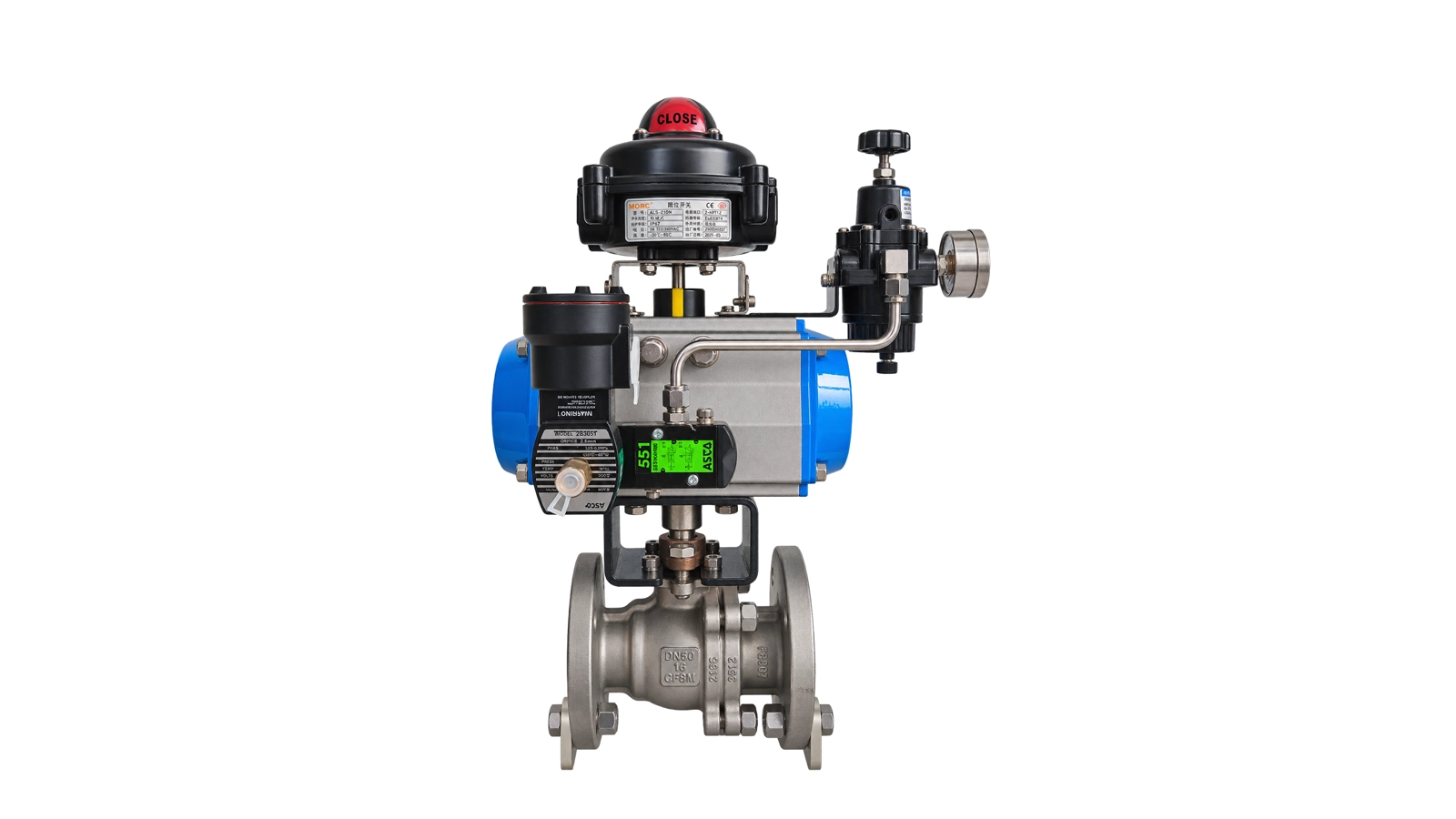
Pneumatic flanged ball valve — front view. Confirm actuator and valve specifications for your order.
Product photographs illustrate viewing angles; the final bill of materials and actuator arrangement are subject to the approved quotation and drawing.
Select the valve for the actual duty
These options come from the supplied floating-ball-valve quotation material. They are configuration references, not a claim that every photographed assembly has identical specifications.
Manual flanged floating ball valve
For a lever-operated shutoff enquiry, specify line size, bore, flange facing, medium, pressure and temperature. The supplied Class 150 RF quotation includes full-bore 2, 3 and 4 inch entries and a separate 6 × 4 inch reduced-bore entry.
- Quoted material option: A352 LCB body, A182 F316 ball, RPTFE seat.
- Confirm face-to-face and flange dimensions before ordering.
- Do not treat the 6 × 4 inch reduced-bore entry as a 6 inch full-bore valve.
Pneumatic or bare-stem enquiry
A separate supplied quotation lists bare-stem Class 150 sizes of 2, 4 and 6 inches for actuator selection. State required fail position, air supply, cycle frequency and control accessories so the valve and actuator can be reviewed together.
- Ask for the torque data and mounting interface for the selected size.
- Confirm single-acting or double-acting actuator requirements.
- Photographs alone do not establish actuator sizing or certification.
Key specification points to confirm
Use the following as a discussion guide when requesting a quote. The approved technical sheet and purchase order determine the supplied configuration.
| Valve type | Floating ball valve; manual lever or actuator-ready configuration, as specified. |
|---|---|
| Connection reference | Class 150 RF flanged options appear in the supplied quotations. Confirm flange standard, facing and drilling on the order drawing. |
| Quoted material option | A352 LCB body; A182 F316 ball; RPTFE seat. Other materials require separate confirmation. |
| Manual quotation sizes | 2, 3 and 4 inch full-bore references; 6 × 4 inch reduced-bore reference. |
| Bare-stem quotation sizes | 2, 4 and 6 inch references in a separate actuator-related quotation. |
| Documents to request | Final datasheet, dimensional drawing, material list and applicable inspection or test records for the agreed order. |
For general flange terminology and the scope of ASME B16.5, see ASME's B16.5 standard overview ↗. This reference link does not certify or verify a particular valve.
Q41F-16C sectional drawing references
Open each drawing to examine the DN25, DN50 and DN200 sections. These PN16 drawing references must be checked independently from the Class 150 RF quotation options above.


What should you send for an accurate quotation?
A floating ball valve selection depends on the actual process and connection requirements. Sharing these details helps the technical team review the correct valve and, when needed, pneumatic actuator.
- Medium and operating temperature
- Design and operating pressure
- Nominal size and required bore
- Flange standard and facing
- Body, trim and seat requirements
- Manual or pneumatic operation
- Fail position and air supply
- Quantity and delivery destination
- Required drawings and records
Floating ball valve selection questions
Answers to the practical questions buyers ask when comparing manual flanged ball valves, pneumatic ball valves and valve drawings.
How does a floating ball valve achieve shutoff?
In a floating-ball design, line pressure moves the ball toward the downstream seat. Seat material, differential pressure, temperature and medium still need to be checked for the actual duty.
What is the difference between a full-bore and reduced-bore floating ball valve?
The flow opening differs. The supplied manual quotation lists full-bore 2, 3 and 4 inch options and a distinct 6 × 4 inch reduced-bore option. Request the bore dimension on the approved drawing rather than selecting by nominal pipe size alone.
Can I order a pneumatic actuator with a flanged floating ball valve?
Ask for a matched assembly quotation. Provide valve size, operating differential pressure, air supply, required fail position, cycling frequency and accessory requirements. Actuator sizing should use the confirmed valve torque data.
Are the Q41F-16C PN16 drawings interchangeable with Class 150 RF drawings?
No. The Q41F-16C DN25, DN50 and DN200 images are separate drawing references. Ask the team to confirm the exact flange drilling, face-to-face dimension and pressure rating for your specified order.
What information is needed to check RPTFE seat suitability?
Send the medium, temperature range, operating and differential pressure, duty cycle and shutoff requirements. The quoted RPTFE seat option should be reviewed against those conditions before selection.
Are ATEX, CE, fire-safe or NACE documents included?
Do not assume these documents are included. List each required standard, certificate and inspection record in your enquiry; availability and applicability must be confirmed in the quotation.
Tell us what the valve needs to do.
Send the service conditions, requested configuration and any existing drawings. Our team can review a manual flanged valve or a pneumatic-actuation enquiry against your project requirements.
Size and bore · Pressure and temperature · Medium · Flange specification · Materials · Manual or pneumatic operation · Quantity · Destination
Review the quotation checklist ↑